



Table of Contents
Home / Use Case / Blockchain
Blockchain in Healthcare: Practical Use Cases With Real-World Examples


The healthcare industry runs on data, and that data constantly has to move between the different institutions a patient touches. Systems exist to make that happen, but they lean on central gatekeepers, which means downtime, bottlenecks and a single point that everyone has to trust. Blockchain takes a different route.
A blockchain gives many parties one tamper-evident record they can all rely on without a central gatekeeper. That is why hospitals, insurers, pharma companies and regulators keep circling back to it. This piece skips the theory and gets straight to the gets straight to the blockchain use cases in healthcare that actually work , with the real projects already running each one.
Blockchain allows all arms of healthcare to share records
First, why is the pull so strong? The problems here are expensive and stubborn.
Healthcare has carried the highest average data-breach cost of any industry for fourteen straight years, reaching $7.42 million in 2025. US regulators have logged breaches exposing more than 846 million records since 2009, and those breaches take roughly 279 days to spot and contain, longer than any other sector.
Blockchain won’t fix all of that. But it goes after the thing underneath most of it: nobody has a shared record they can genuinely trust. If you want the mechanics, benefits, and trade-offs in full, our blockchain in healthcare guide covers that ground. This piece stays on the use cases, and many of them are already live.
Blockchain Use Cases in Healthcare
We have compiled 19 use cases of blockchain in healthcare, with the table below listing each one, its functions, and live examples of each. You can find a detailed explanation of each one right below the table:
| Use case | What it does | Live example |
| Health Information Exchange | Shares EHR data through a common permission layer | Estonia (Guardtime) |
| Patient Identity Management | One verifiable identity across providers | Emerging |
| Medical Data Sharing | Patients control access with cryptographic keys | Emerging |
| Patient Consent Management | Time-stamped, permanent consent log | Emerging |
| Healthcare Claims Processing | Smart contracts adjudicate on a shared ledger | Health Utility Network / Avaneer |
| Health Insurance Verification | Instant coverage checks at the point of care | Emerging |
| Healthcare Payments | Auto-releases payment once care is verified | DokChain (now Change Healthcare) |
| Drug Supply Chain Management | Tamper-proof record of every drug handoff | MediLedger (Chronicled) |
| Counterfeit Drug Prevention | Verifiable, unrewritable product origin | MediLedger |
| Prescription Management | One consistent prescription history | Emerging |
| Clinical Trials | Immutable audit trail for trial data | Triall |
| Provider Credential Verification | Shared ledger of verified credentials | ProCredEx (R3 Corda) |
| Healthcare Research | Auditable, consent-driven data sharing | BurstIQ |
| Precision Medicine | Secure, consent-driven multi-source data | Emerging |
| Telemedicine | Ties virtual visits to a verified identity | Emerging |
| Remote Patient Monitoring | Proves device readings were not tampered with | Emergin |
| Medical Device Tracking | Full device history for recalls and audits | Emerging |
| Organ Donation Management | Tamper-proof donor and chain-of-custody records | Emerging |
| Vaccine Distribution | Cold-chain provenance plus immunization records | Emerging |
Records, Identity, and Data Sharing
- Blockchain for Health Information Exchange. Blockchain lets providers share electronic health records (EHR) through a common permission layer, so a hospital, a lab, and a clinic reach the same authorized data instead of faxing records back and forth. The chain tracks consent and access while the records stay put.
Live example: Estonia secures its nationwide e-health records with KSI blockchain technology, giving every citizen a tamper-evident log of who has viewed their data. It has run at national scale for years, not as a pilot.
- Patient Identity Management. Mix up two patients, and you get duplicate files, or worse, a real clinical error. A blockchain-based ID gives each person one identity that follows them from provider to provider, which quietly kills a huge share of record-matching headaches for big hospital networks. The identity resolves the person while the clinical data stays off-chain, which removes a whole class of dangerous matching errors without moving any sensitive record onto a ledger.
- Medical Data Sharing. This one flips the usual setup. With cryptographic keys, patients grant and pull access to their own records themselves. A specialist gets read access for a defined window, a research study gets a narrow slice, and the patient can pull either one back at any time. The data stops being a file trapped in one provider’s database and becomes something the patient genuinely controls, with every grant recorded so there is never a question about who was allowed to see what.
- Patient Consent Management. Consent usually lives in paperwork nobody can audit quickly. This becomes a real problem the moment a regulator or a lawyer asks what a patient actually agreed to. On a blockchain, every grant or withdrawal is time-stamped and made permanent. An organization can then prove exactly what a patient consented to, and when, without digging through filing cabinets or email threads. It is a small use case with an outsized payoff in any audit.
Claims, Insurance, and Payments
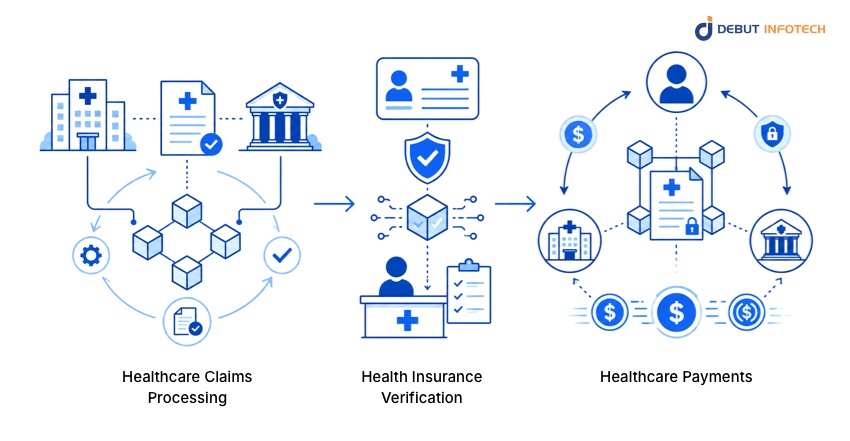
- Blockchain for Healthcare Claims Processing. Claims drag because providers and payers each reconcile their own separate records. Move the claim onto a shared ledger and a smart contract can validate and adjudicate it on its own, the moment the agreed conditions are met. That is a direct hit on the administrative paperwork that swallows a large share of every healthcare dollar, and it shortens the reconciliation cycle from weeks toward something close to real time.
Live example: The Health Utility Network (now known as Avaneer Health), founded in 2019 by Aetna, Anthem, HCSC, PNC Bank, and IBM, set out to tackle claims and provider directories on a shared blockchain. It later became the independent venture Avaneer Health, which continues to build shared infrastructure for claims and data exchange across major payers.
- Health Insurance Verification. Coverage checks still happen over the phone or through a clunky portal, which leaves patients and front-desk staff guessing about what is actually covered. Put the policy rules on a blockchain and a smart contract can confirm eligibility on the spot, right at the point of care. The patient learns what they owe before treatment rather than weeks later in a surprise bill, and the provider stops chasing eligibility confirmations by hand.
- Healthcare Payments. Settlement between patients, providers, and payers is slow and oddly fragmented. Smart contracts can release payment the moment care is verified, and stablecoin rails can even move cross-border medical payments without the usual multi-day banking lag. Earlier work like PokitDok’s DokChain, later absorbed into Change Healthcare, showed the appetite for on-chain healthcare transactions well before the current wave, which is a useful reminder that this idea has a track record, not just a pitch deck.
Pharma Supply Chain and Drug Safety
- Blockchain for Drug Supply Chain Management. This is one of the most proven uses, full stop. Every handoff of a drug, from manufacturer to distributor to pharmacy, gets logged in a history nobody can quietly rewrite, so provenance is verifiable end to end. In the US, the Drug Supply Chain Security Act now requires an interoperable electronic tracing system, and a shared ledger fits that mandate almost too neatly. The product identifiers and the transaction trail live on-chain; the commercial detail each party wants to keep private does not.
Live example: MediLedger, built by Chronicled, lets manufacturers, wholesalers, and distributors such as Cardinal Health verify drug provenance on a shared ledger. It uses zero-knowledge cryptography so direct competitors can confirm a product’s history without exposing sensitive business data to each other, which is the design detail that made large pharma players willing to join.
- Counterfeit Drug Prevention. Same traceability, different payoff. Because a product’s origin is verifiable and can’t be rewritten after the fact, a pharmacist or wholesaler can confirm a package is real before it ever gets near a patient. In markets where falsified medicines are a real danger, that verification step is the difference between a safe dispense and a harmful one, and it happens in seconds against the same ledger the supply chain already uses.
- Blockchain for Prescription Management. Log prescriptions on a shared ledger and duplicate or forged scripts get a lot harder, which really matters for controlled substances. Pharmacies and prescribers finally see one consistent history instead of their own partial view, so a patient cannot quietly collect the same opioid script from three different clinics. The prescription record is shared and permanent; the underlying clinical notes stay where they belong.
Trials, Credentialing, and Research
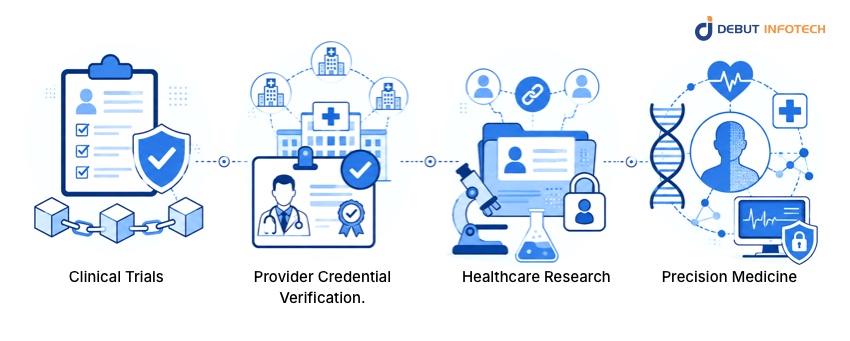
- Blockchain for Clinical Trials. Regulators worry constantly about whether trial data got massaged. Anchor the documents and results to a blockchain and you have an audit trail that proves nothing was changed later, which makes selective reporting and quiet data edits far harder to hide. That raises confidence in the outcome for regulators, sponsors, and the patients who volunteered, and it gives an auditor a single source of truth to check against.
Live example: Triall Blockchain Proof anchors trial documents and data to a blockchain to give regulators stronger assurance that records were not altered.
- Provider Credential Verification. Credentialing a doctor across hospitals is slow and repetitive, and everyone re-does it from scratch, which can leave a qualified physician sitting idle for weeks. A shared ledger of verified credentials lets any approved institution confirm a provider’s licenses and history in minutes rather than weeks. The verification is done once and trusted many times, so a locum working across five hospitals is not re-vetted five separate times.
Live example: ProCredEx runs a distributed ledger of verified healthcare credentials on R3’s Corda.
- Healthcare Research. Researchers need data they can trust, and patients willing to hand it over. A blockchain can set up auditable data-sharing agreements and let patients feed their records into a study while keeping a say in how they’re used and for how long. That consent-with-control model makes people far more comfortable sharing, which is exactly what starved research datasets need.
Live example: BurstIQ runs a platform that lets healthcare organizations store, share, and even monetize health data with granular, patient-level consent built in.
- Precision Medicine. Personalizing treatment means pulling together genomic, clinical, and lifestyle data from many sources, and that data is about as sensitive as it gets. Blockchain gives the mix a secure, consent-driven layer to move through, so clinicians and researchers can assemble a full picture of a patient without trampling privacy or losing track of who contributed what. The consent and provenance sit on-chain; the genomic files themselves stay in secure off-chain storage.
Connected Care and Devices
- Blockchain for Telemedicine. Remote care scatters data across apps, devices, and different providers, which makes a trustworthy record of a virtual visit surprisingly hard to keep. Blockchain can tie all of it back to one verifiable patient identity and log every access along the way, so the platform has a record of consultations it can actually stand behind for billing, liability, and continuity of care.
- Remote Patient Monitoring. Wearables and home devices stream readings clinicians have to be able to trust before they act on them. Hash that data to a blockchain as it lands and you can prove it was not tampered with in transit, which counts for a lot when a treatment decision hangs on a single blood-pressure or glucose reading from a device sitting in someone’s kitchen.
- Blockchain for Medical Device Tracking. A large hospital might juggle thousands of devices, each with its own maintenance and safety trail. A blockchain ledger follows a device from the factory through every service event and software update, which is exactly what you want when a recall, a warranty claim, or a safety audit lands on your desk. Instead of reconstructing a device’s history from scattered logs, you query one immutable record.
- Organ Donation Management. Matching a donor to a recipient lives or dies on records nobody can fake, and the stakes could not be higher. A blockchain can track donor registries and an organ’s chain of custody in the open, which cuts the room for fraud and error in a process where trust is everything and a single tampered record could cost a life.
- Vaccine Distribution. Vaccines need an intact cold chain and a clear record of who got what. Blockchain pairs supply-chain provenance with verifiable immunization records, so a spoiled batch is caught before it is administered and a vaccination certificate can be checked without a central database. It proved genuinely useful during recent mass-vaccination campaigns, where both cold-chain integrity and trusted records mattered at once.
The pattern across every live project is the same. Each solution focuses on solving one specific problem rather than transforming an entire healthcare system at once. Moving from a blockchain use case to a production-ready application requires careful planning, compliance, and development expertise, which is where a healthcare app development company plays a key role.
Have a healthcare use case in mind?
Talk to Debut Infotech’s blockchain team about scoping a compliant, HIPAA-ready pilot.
What Goes On-Chain and What Stays Off-Chain
This is the question every healthcare team asks first, and getting it right is what keeps a design HIPAA-friendly. The rule of thumb is simple: protected health information never touches the chain. The ledger holds the proof, and the sensitive record stays in secure storage you already control.
| Use-case type | On the ledger | Off-chain (secure storage) |
| Records and identity | Access permissions, consent grants, a hash of the record, the audit log | The EHR itself, images, notes, genomic files |
| Claims and payments | Claim status, adjudication rules, payment triggers, settlement record | Full clinical detail behind the claim |
| Pharma supply chain | Product identifiers, chain-of-custody events, verification proofs | Commercial pricing and private business data |
| Trials and research | Document hashes, timestamps, consent, the integrity trail | Raw trial data and participant records |
| Devices and monitoring | Device history, a hash of each reading, service events | The raw device data stream |
Read down that middle column and you’ll notice a theme. What lives on-chain is small, non-sensitive, and about trust: who did what, when, and whether a record has been altered. That split is the whole trick, and it is what lets a blockchain add auditability without turning private data into something exposed forever.
Choosing the Right Blockchain Platform for Healthcare
The platform matters as much as the use case. Regulated, multi-party healthcare work almost always calls for a permissioned network, but the right one depends on what you are building.
Ready to build a blockchain-powered healthcare solution?
Most production healthcare systems land on Fabric or Corda because permissioned control is not optional when regulators are involved. Public chains still show up, but usually at the edges, for a patient-controlled identity or a payment rail, never as the store for a raw medical record.
Healthcare Blockchain Standards Every Enterprise Should Know
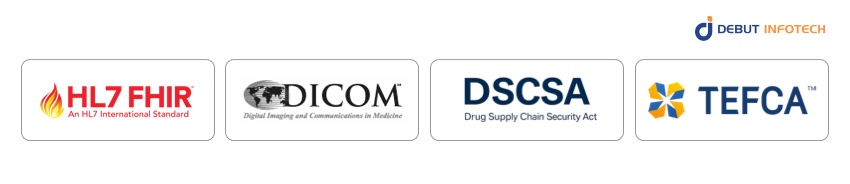
A ledger only earns its place if it speaks the languages your systems already use. In healthcare, a handful of standards are non-negotiable, and any serious build accounts for them from the start.
- HL7 FHIR. The modern standard for exchanging clinical data. Your blockchain connects to EHRs and clinical software through FHIR, so records move between the ledger and the systems that hold them without custom glue.
- DICOM. The standard for medical imaging. When a use case touches scans, the ledger references DICOM objects in off-chain storage rather than the images themselves.
- DSCSA. The US Drug Supply Chain Security Act, which now mandates interoperable electronic tracing. Any drug supply-chain or anti-counterfeit build has to map directly to it.
- TEFCA. The US framework pushing organizations to exchange data on common terms. A records or health-information-exchange project should align with it rather than reinvent the rules.
Which Healthcare Blockchain Use Cases Are Ready for Adoption?
Not every one of these healthcare blockchain use cases is equally ready , and it helps to be honest about that before you build. Here is where things actually stand in 2026.
- Live and proven. Drug supply chain and counterfeit prevention (MediLedger), national records integrity (Estonia), clinical-trial integrity (Triall), and provider credentialing (ProCredEx) all run in production today. If you need a safe first project, start here.
- Piloting and scaling. Claims processing and provider directories (Avaneer), and consent-driven research data (BurstIQ), are past the demo stage and expanding, though not yet universal.
- Emerging. Patient-held identity, insurance verification, remote monitoring, device tracking, organ donation, and vaccine records are real and promising, but most sit in pilots or early deployments. The technology is ready; the multi-party agreements and standards are still catching up.
The takeaway is not that the emerging ones don’t work. It is that the proven blockchain healthcare applications give you the safest first build.
Which Use Cases Matter Most for Your Organization
The most valuable healthcare blockchain use cases vary based on your organization’s role, operational priorities, and business objectives.
- Hospitals and health systems. Start with health information exchange, patient identity, and consent. The payoff is fewer duplicate records and far less time lost chasing data across departments.
- Payers and insurers. Claims processing and eligibility verification are the fastest wins, because they attack the administrative cost sitting inside nearly every policy.
- Pharma and distributors. Supply-chain traceability and counterfeit prevention, where regulation is already pushing you toward interoperable electronic tracing.
- Research and life sciences. Clinical-trial integrity and consent-driven data sharing, which make results easier to audit and datasets easier to pool responsibly.
What to Get Right Before You Build
Most healthcare blockchain projects that stall don’t fail on the engineering. They fail on decisions made in the first few weeks. Five things are worth settling before a line of code gets written.
- The on-chain and off-chain split. Decide exactly what proof lives on the ledger and confirm no protected health information ever does. This one call shapes compliance more than anything else.
- The standards you integrate through. A ledger is only useful if it exchanges data with the systems you already run, which in healthcare means HL7 FHIR and your existing EHR. Plan those touchpoints early, not as an afterthought.
- Consent, designed as a feature. Model how patients grant, limit, and revoke access from the start. Retrofitting consent onto a live ledger is painful and sometimes impossible.
- An independent audit before launch. Anything that touches funds or sensitive records goes through outside review before it runs in production. Budget for the remediation pass too.
- Partner alignment. A network only delivers value when several organizations join it, and that agreement usually takes longer than the build. Line up your first partners before you scale.
Get those five right and the technical work becomes routine. Skip them and even a well-built ledger ends up as an expensive island nobody else will join.
Why Healthcare Organizations Choose Debut Infotech
A compliant healthcare blockchain build needs two kinds of expertise at once: deep distributed-systems engineering and a real feel for how regulated health data has to be handled. As a healthcare software development company, we work across both, and we have shipped production blockchain since 2015. Here is how that maps to the use cases above.
- Records, identity, and consent. We design permissioned networks on Hyperledger Fabric that keep protected health information off-chain and put only hashes, permissions, and the audit trail on the ledger, integrated with your EHR through HL7 FHIR.
- Claims and value-based care. We build smart-contract adjudication and outcome-based contracting on R3 Corda, so payments release automatically once verified conditions are met.
- Supply chain and trials. We build traceability and data-integrity systems with independent smart contract audits before anything touches production, using smart contract development practices tuned for regulated data.
You can explore our blockchain development services for the full picture.
Our process is deliberately narrow at the start. We scope one high-value use case, design the on-chain and off-chain split around HIPAA and GDPR from day one, integrate through standards rather than custom glue, and put the whole thing through independent audit before a bounded pilot. You can explore our full custom blockchain development services for the complete picture.
A healthcare blockchain we built: We engineered a value-based care platform on R3 Corda, with decentralized health records, a private permissioned ledger, and smart contracts that automate outcome-based contracting and claims reconciliation in real time. It connects diverse health-data sources through digital identities so stakeholders can exchange information without giving up control of it, and it went on to raise seed and angel funding. Read the full case study.
On the supply-chain side, our iFinca traceability network on Hyperledger Fabric shows the same discipline applied to provenance, the exact pattern that drug supply-chain and cold-chain vaccine tracking rely on.
That same discipline carries across every domain we build in. Beyond healthcare, our blockchain portfolio runs deep:
- Supply chain and provenance. Everledger, a blockchain authentication and traceability platform for luxury goods on Hyperledger Fabric. The provenance pattern here is the same one drug supply-chain and vaccine tracking rely on.
- Legal and document integrity. Integra Ledger, a blockchain e-signing and document-integrity platform for the legal industry.
- Capital markets. KoreConX, a private blockchain for compliant capital raising that automates KYC and AML checks and cuts compliance time by roughly half.
- DeFi and exchanges. Alongside NDAX, we have engineered exchange and DeFi infrastructure for OKX, a full-stack DeFi ecosystem for PRC on BNB Chain, real-estate tokenization for RVA, and further DeFi builds including Encrypted Cash and Yieldz. Explore our DeFi development services.
Ready to build a blockchain-powered healthcare solution?
Let’s connect with our blockchain and healthcare engineers to map your first production use case.
Frequently Asked Questions
Q. Which blockchain healthcare use case is most mature?
The most mature blockchain applications in healthcare are drug supply chain, records integrity, and clinical-trial integrity. Drug supply chain management is the clearest. It runs in production through networks like MediLedger, it is backed by regulation such as the US Drug Supply Chain Security Act, and the economics are obvious. National records integrity, clinical-trial integrity, and provider credentialing are close behind, each with a live reference you can point to.
Q. Which use cases are actually live versus still experimental?
Live today: drug traceability, counterfeit prevention, Estonia’s national records, clinical-trial integrity, and credentialing. Piloting and scaling: claims and provider directories, plus consent-driven research data. Still emerging: patient-held identity, insurance verification, remote monitoring, device tracking, organ donation, and vaccine records. The emerging ones work technically; they are waiting on multi-party agreements and standards.
Q. Is blockchain in healthcare HIPAA compliant?
It can be, when designed correctly. Compliance depends on keeping protected health information off-chain, using a permissioned network with strict access control, and storing only hashes and permissions on the ledger. A design that put raw patient data on a chain would not be compliant, which is why the on-chain and off-chain split matters more than the technology label.
Q. Which use cases fit a hospital versus a payer or a pharma company?
Hospitals get the most from records exchange, patient identity, and consent. Payers benefit first from claims processing and eligibility verification. Pharma companies and distributors lead with supply-chain traceability and counterfeit prevention. Research organizations focus on trial integrity and consent-driven data sharing. The right first project follows what your organization actually does.
Q. Does a healthcare blockchain replace our EHR?
No, and this is a common misconception. A blockchain runs alongside your EHR, not instead of it. The clinical records stay in the EHR and your other systems, while the ledger adds a shared layer of permissions, consent, and an audit trail on top. Think of it as a trust layer between organizations, not a new place to store medical records.
Q. What standards does a healthcare blockchain need to support?
At a minimum, HL7 FHIR for exchanging clinical data, and DICOM where imaging is involved. Drug supply-chain builds also have to meet the US Drug Supply Chain Security Act, and records-exchange projects should align with the TEFCA framework. A build that ignores these ends up isolated from the systems it was meant to connect.
Talk With Our Expert
Free 30-min consultation. No commitment.
Our Related Insights


Talk With Our Expert
LET'S WORK TOGETHER
Your Vision.
Our Engineering.
Debut Infotech works as a strategic co-creator — from concept to production-ready platform. We deliver blockchain, AI, enterprise, & mobile solutions that scale.

15+ Years · 500+ Platforms Delivered
Across blockchain, AI, fintech, mobile, and enterprise verticals

NDA Signed on Day One
Your IP and project details are protected before any conversation begins

48-Hour Scoped Estimate
A real technical estimate — not a generic template or sales pitch

Dedicated Account Managers
Available across key global time zones
 +1 708-515-4004 (USA)


